Fish Oil- more than just skin and coat!
Changing the Environment of Pain
I have been helping with adjusting and choosing fishoil suppleemnt with many of my patients recetnly. There is a lot of confusion about why and how much fish oil we should be giving our pets. I hope this can give a little clarification, and even inspiration to supplement effectively and with an understanding of the benefits you are providing! It is a very valuable supplement for patients dealing with pain and mobility issues, but also those what are active, competitive, recovering, growing, or aging.
When I recommend fish oil for a patient, I’m rarely thinking about it as just a “joint or skin/coat supplement.” I’m thinking about the environment that pain lives in. Because pain—especially chronic pain—isn’t just about a joint, a tendon, or a nerve. It’s about how the body processes inflammation, how the nervous system responds, and how those systems interact over time. One of the most powerful (and often overlooked) ways we influence that system is through what becomes part of the cell membrane.
Every cell in your dog’s body is wrapped in a membrane made up of fatty acids, and those fatty acids are not passive—they are the starting material for inflammatory signaling. When tissue is stressed or injured, the body pulls from the cell membrane to create signaling molecules called eicosanoids. These molecules regulate inflammation, immune responses, blood flow, and pain. The body doesn’t choose these building blocks—it uses what’s available, which means diet directly influences the type of inflammatory signals that are produced.
Many dogs, even on high-quality diets, have cell membranes that are rich in omega-6 fatty acids, which tend to drive stronger, more pro-inflammatory signaling. When we add omega-3 fatty acids—specifically EPA and DHA from fish oil—we begin to change that balance. Over time, these omega-3s are incorporated into the cell membrane and compete with omega-6 fatty acids.
This shift leads to:
Less production of pro-inflammatory mediators
More production of compounds that help resolve inflammation
A more controlled, less reactive inflammatory response
We’re not just turning inflammation down—we’re helping the body complete the process more appropriately.
For dogs with arthritis or injury, this often shows up as:
Less joint inflammation
Less swelling
Less sensitivity to movement
But where this becomes even more meaningful is in chronic pain. Over time, the nervous system can become more reactive, amplifying pain signals even when the original injury is no longer the whole story. Omega-3 fatty acids help here as well by:
Reducing neuroinflammation in the spinal cord and brain
Supporting more stable nerve signaling
Helping quiet amplified pain pathways
They don’t just change the source of pain—they change how the body processes it.
This is where dosing and quality become critical. Most pet foods contain some omega-3 fatty acids, but for therapeutic effects—especially in dogs dealing with pain—the amounts are usually not enough. For meaningful impact, we typically aim for:
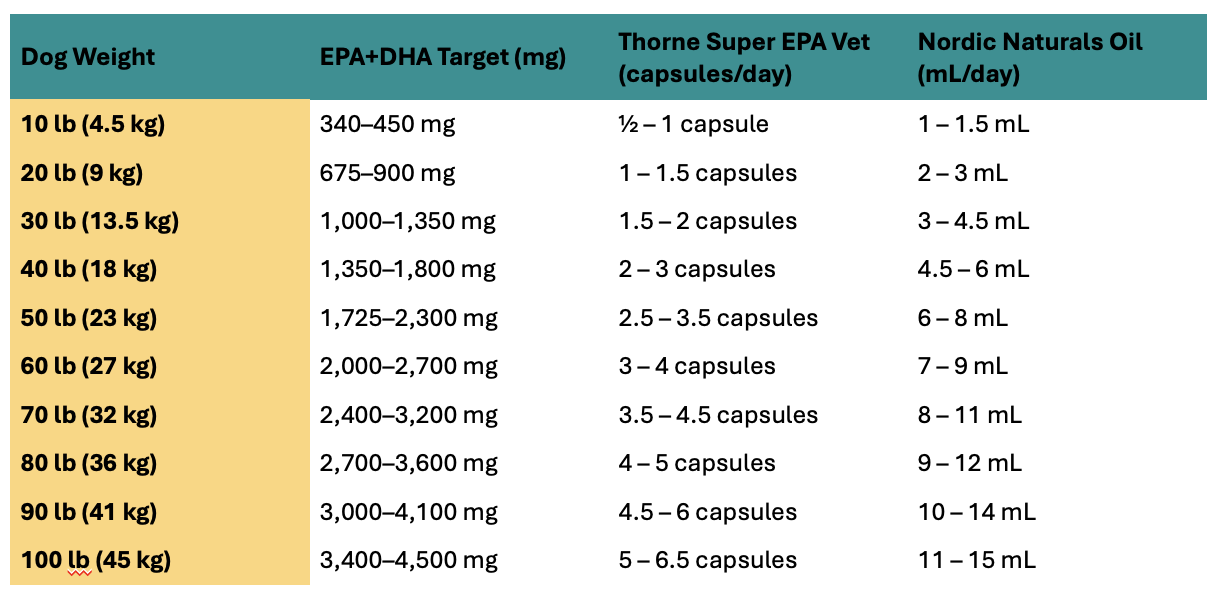
75–100 mg/kg/day of combined EPA + DHA
Quality matters just as much as dose. Fish oil is delicate, and poor-quality or oxidized products may not provide the benefits we’re looking for. When choosing a product, look for:
Clearly labeled EPA and DHA content
Reputable sourcing and testing
Freshness and proper storage
Fish oil is not a stand-alone solution, and it is not a quick fix. It works best as part of a thoughtful, comprehensive plan. But it is one of the ways we can begin to shift the internal environment—making the body less likely to sustain inflammation and less likely to amplify pain signals over time.
It is especially helpful for dogs who are:
Living with osteoarthritis
Recovering from injury
Dealing with chronic or neurologic pain
Aging and showing subtle mobility changes
Competing in athletics, working, or active companions
Fish oil doesn’t work like a traditional pain medication. It works by changing the conditions that allow pain to persist. And when used thoughtfully—with the right dose, the right product, and as part of a bigger plan—it can make a meaningful difference in how a dog moves, feels, and experiences their world.
I would love to help you with fish oil dosing and answer questions! Here is a quick chart that references two of the fish oils I use a lot! Work your way up to the recommended dose, to avoid any soft or loose stools!